How Threats Think: Threat Profiling Psychology
Exploring more than 30 real-world cases of Terrorism, Extremism, Activism, Fraud and Deception, revealing the thinking behind human behaviour.
Order Your Copy · £24.99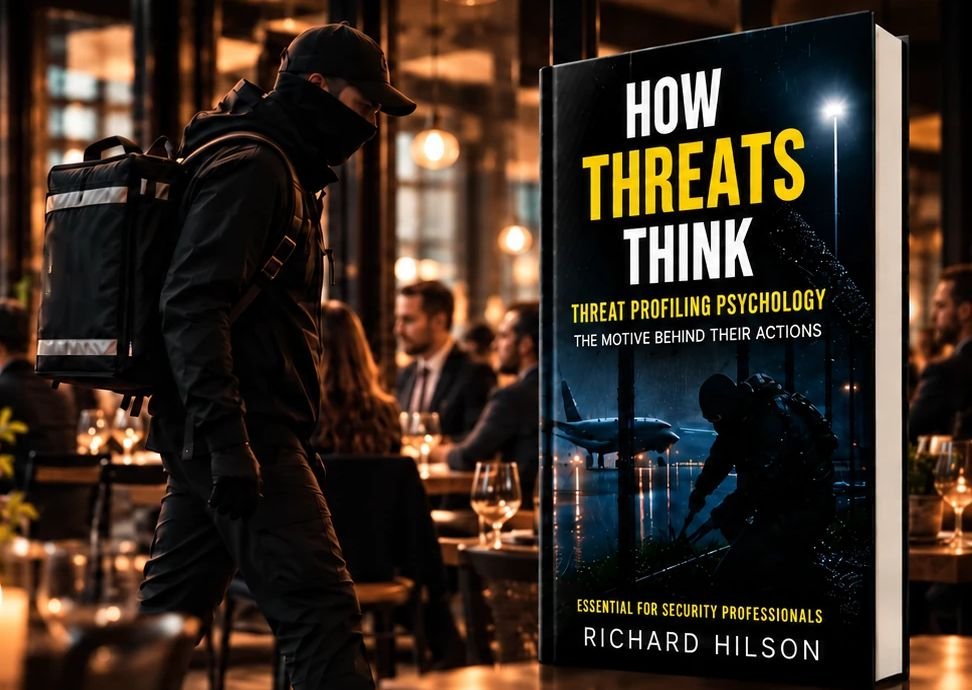
DRAFT: Beware of the Deceiver
DRAFT: Threat actors are becoming increasingly difficult to define. Their profiles are less clear-cut, their motivations more complex, and their ideologies increasingly unstable - morphing through personal grievances and shifting beliefs.
DRAFT: No longer confined to the shadows, threats may be hiding in plain sight.
DRAFT: Discover the traditional threat archetypes (the Opportunist, the Activist, the Radicalist, the Extremist and the Terrorist) and explore the emergence of the Deceiver, a threat that blends into everyday life, often overlooked, underestimated and unrecognised until it is too late.
- Opportunist Exploiting Vulnerability
- Activist A cause
- Radicalist The Challenger
- Extremist Selective Bias
- Terrorist Symbolic violence
- The Deceiver Hidden in Plain Sight
About the book
How Threats Think takes readers inside the minds of those who pose a threat. It reveals how motives, perceptions, needs and drives shape human behaviour, and how seemingly ordinary thinking can evolve into actions that endanger people and places.
Drawing on real-world incidents, established psychological theories and practical security experience, author Richard Hilson challenges conventional approaches to recognising and understanding threat actors.
Every threat begins somewhere. Long before the act, there is a thought, a belief, and a turning point.
How Threats Think takes readers into the hidden psychology of human threats, revealing the Spectrum of Intent: the journey from thought and belief to conviction, commitment and action.
The book introduces MindFrames, a revolutionary new behavioural framework that uncovers the forces shaping human behaviour: motivation, interpretation, need and drive.
By exposing the subtle shifts that signal an emerging threat, MindFrames challenges how we recognise danger, helping identify emerging threats early enough to intervene before they escalate into action.
Because by the time a threat becomes visible, the opportunity to prevent it may already be gone.
DRAFT: MINDFrames®
DRAFT: By the time a threat becomes visible, the thinking behind it may already be dangerously advanced.
DRAFT: Investigators are often forced to work backwards: reconstructing events, connecting fragments of evidence and tracing the path that transformed thought into action.
DRAFT: How Threats Think presents a way of turning that perspective around.
DRAFT: Drawing on real-world case studies and using the MindFrames MIND model, we explore the psychological journey that can begin long before a threat is recognised: the thoughts, motivations, perceptions and needs that gradually shape what happens next.
DRAFT: Through four powerful dimensions, Motive, Interpretation, Need and Drive, MindFrames provides a new way of examining how intent can begin to form and gather momentum towards action.
- Motive
- Interpretation
- Need
- Drive
Meet the author: Richard Hilson

Richard Hilson brings an interesting perspective to this psychologically motivated book, shaped by experience gained across both military and international business environments. As a former combat soldier, Richard specialised in jungle and alpine warfare, developing an early understanding of human behaviour, resilience and decision-making under pressure.
He later built an international business career, leading cross-cultural teams across Oceania, the Americas, Asia, the Middle East and Europe. Working across diverse cultures and environments has given Richard a particular insight into how people interpret situations, and how behaviour can evolve in response to pressure and circumstance.
These experiences have shaped his exploration of human behaviour and threat psychology. More importantly, Richard shares his understandings on how intent develops and how it can be understood early enough to influence outcomes.
Understand the thought.
Influence the outcome.
For Those Entrusted to Protect.
DRAFT: Hardback, £24.99, with free delivery to UK addresses.
Order Your Copy